Fallout 4 is the game I spent half of 2015 suffering through sleepless nights waiting for. The Witcher 3 Wild Hunt is, bar none, the best game I have ever played. And it was out a month before Fallout was even announced.

The reviews of Canucks that love movies, books, and video games more than can possibly be considered healthy or sane.
Showing posts with label Video Games. Show all posts
Showing posts with label Video Games. Show all posts
Saturday, 13 February 2016
The Witcher 3: Wild Hunt (Video Review)
Fallout 4 is the game I spent half of 2015 suffering through sleepless nights waiting for. The Witcher 3 Wild Hunt is, bar none, the best game I have ever played. And it was out a month before Fallout was even announced.


Friday, 20 November 2015
Video Game Review: Fallout 4
The long sleepless nights are finally over. But you know what, Fallout 4 was worth suffering every second of them.
Wednesday, 28 October 2015
Video Game Review: The Witcher 3: Wild Hunt - Hearts of Stone

Title: The Witcher 3: Wild Hunt - Hearts of Stone
Developers: CD Projekt Red
Publisher: Warner Brothers Interactive
Genre: Action Role-Playing-Game
Platforms: PC, Playstation 4, Xbox One
Reviewed On: PC
Price: $9.99 ($7.99 on GOG.com, once again, for you PC people)
NOTE: Hearts of Stone Requires The Witcher 3: Wild Hunt to Run. Do not buy it if you don't own The Witcher 3.
It's not very often I find DLC for games very satisifying, nevermind worth writing a review for. This year has been especially true for this. Not to say it's all bad, there just really isn't a lot to say about it. Once again, I get to ramble on about how great The Witcher 3 is (seriously, if you own a strong PC or one of the new consoles, pick up The Witcher 3, you won't regret it) with this new DLC, Hearts of Stone. It has everything in it that made The Witcher 3 great, and as always, CD Projekt Red doesn't feel the need to gouge you for that hard earned cash in your wallet.
As always, the writing in Hearts of Stone is top notch. None of the major characters are as they seem, and have some mystery or hidden past to them. Some I somewhat expected, some not so much. One main character has a bit of a generic storied past to him, but it's fleshed out in so much delicious detail that I feel a bit bad for saying that. It's difficult to talk about without spoilers, but at the end of it, he feels like one of the most detailed and fleshed out characters in the entire video game. For all the 2 of you Witcher veterans reading this, a certain red-headed medic makes a return, and plays an important part in the plot.

I rambled about the characters, but I should also ramble about the storyline, and how much enjoyment I had going through it. It starts out somewhat slow, with a fairly basic monster contract, but gains momentum and doesn't stop. You get a little bit of everything, from weddings to heists, each with it's own little Witcher twists. The wedding in particular had laughing from start to end, and is a highlight of the DLC.
I could ramble on about the story forever, but this is a game, and we need to talk about the gameplay. There aren't a ton of new base mechanics or anything like that to relearn, much of the gameplay is just more content for you to talk and slice your way through. Several new enemy types are introduced, and even better, they are actual new types, instead of reworked old versions of monsters. There's two new types, one are spiders, who will poke in and out of darkness to bite you, and only fully attack when you they are in a group. They are incredibly annoying, and are a blast to fight. The other is a massive toad, and those of you familiar with older Fantasy tales might see where that is going.

The biggest new addition though, is the Runewright. Using upgrade runes from the base game, you can create new upgrades for your weapons, which allow you to alter the ways your weapons and abilities behave, allowing more player customization than the base game. The runes in the base game kinda failed in this regard, and were mostly for small base stat upgrades, the Runewright remedies this however.
But what about the problems? Everything has some flaws or missteps, and Hearts of Stone is no different. The story takes a bit to really get rolling, and it seems the health of some enemies, or the damage they take is a bit off. This made the toad boss fight pretty rough, as it seems that all I could do was grind away at it's massive health pool, and it got old pretty quick. The same goes for some human enemies, though not nearly as bad, yet it's still noticeable. While these are annoying, they don't ruin the storyline or the characterization, which are top notch.
Once again, CD Projekt Red shows that they are willing to treat their customers with respect. For the price of a Subway footlong, you get a great piece of additional content that gels perfectly with the rest of the game. While it has it flaws, they don't make this any less worthy of your cash. With it's 10ish hours of high quality content, it's definitely worth the cash, and if you are even a remote fan of the base game, you will enjoy this.
The Pros:
- Fantastic Characters
- Improved Customization
- Thrilling Storyline
The Cons:
- Slow Start
- Some Wonky Difficulty
Final Score: 9.5 out of 10
Saturday, 23 May 2015
Video Game Review: The Witcher 3: Wild Hunt

Title: The Witcher 3: Wild Hunt
Developers: CD Projekt Red
Publisher: Warner Brothers Interactive
Genre: Action Role-Playing-Game
Platforms: PC, Playstation 4, Xbox One
Reviewed On: PC
Price: $69.99 ($46.99 on GOG.com, for you PC people)
I've been playing video games for years now, and have played through dozens of titles, from indie titles to massive AAA releases. Drawing from this experience, I can say, with confidence, that The Witcher 3 is some of the tightest, most well thought-out gaming I have experienced in years. Not since The Elder Scrolls 3 or Dragon Age: Origins have I been this addicted and drawn into a fantasy world, and if you've got an Xbox One, PS4, or a decently powerful PC, you need to play The Witcher 3.
The game's strongest point is its atmosphere, and in this regard, it hits the ball out of the park and straight to the moon. There's so many little details in every scene, from the trees along the trail you travel blowing from the wind, to the little conversations the city people are having as you pass by. CD Projekt Red put a ton of work into this regard, and it absolutely shines through, it recreates the low-fantasy atmosphere of The Witcher flawlessly.
The atmosphere may steal a lot of the show, but that doesn't mean the writers have slacked off either. For the huge amount of conversations and questing in The Witcher 3, it's impressive how the quality of it all has been kept at a high bar. The conversations all feel at least interesting, and all work towards some purpose, be it the main story, character development, or just an NPC telling you details on your next job, it's all kept up with spot-on writing, and great delivery from the voice actors.

Before I touch on the gameplay, I should mention the storyline as well, this being an RPG and all. The storyline is a great send-off for The Witcher trilogy, bringing back some familiar characters and introducing some new ones as well, each having some side quest for you to complete, letting you see how they're doing now. The main plot mainly concerns Geralt of Rivia's newest contract, to track and find the daughter of a prominent emperor, her name being Ciri, with the daughter also having a personal connection to Geralt. He has to work fast though, as the spectral riders, the Wild Hunt, are chasing Ciri, and it probably won't be good if they reach her first. While the main story can sometimes be overshadowed by some of the side quests, it's still kept interesting, and will keep dragging you back, even when you want to go out messing around in the open-world.
That's, by far, the biggest change in The Witcher 3, compared to the first two, the game is set in an open world, letting you go wherever you want, whenever you want (though the monsters you find may not agree with that). This formula works surprisingly well with The Witcher, as Witcher's within this world are wandering monster-slayers, and it's very satisfying to wander into a medieval style farmer village, and grab a monster contract from the nearest billboard, only to continue wandering after you slay it and get your pay, kinda like a lone wandering cowboy from some Old West fiction.
But these are monsters you're fighting after all, and being monsters, they like to make sure killing them isn't easy. Many times, a monster is stronger than Geralt in a direct fight, so that's not always an option. Geralt wouldn't be a century old if he was an idiot though, and so he has a few tricks up his sleeve to even the odds. Geralt has two swords at his disposal, a steel sword for humans and more mundane beasts, and a silver sword for the more fantastical variety. It's important to know which one to use, as many monsters in The Witcher don't take a lot of damage from steel. Not only that, Geralt also has a variety of bombs, potions, blade oils, spells, and even a crossbow. With proper preparations, you can take on all the monsters in the world.
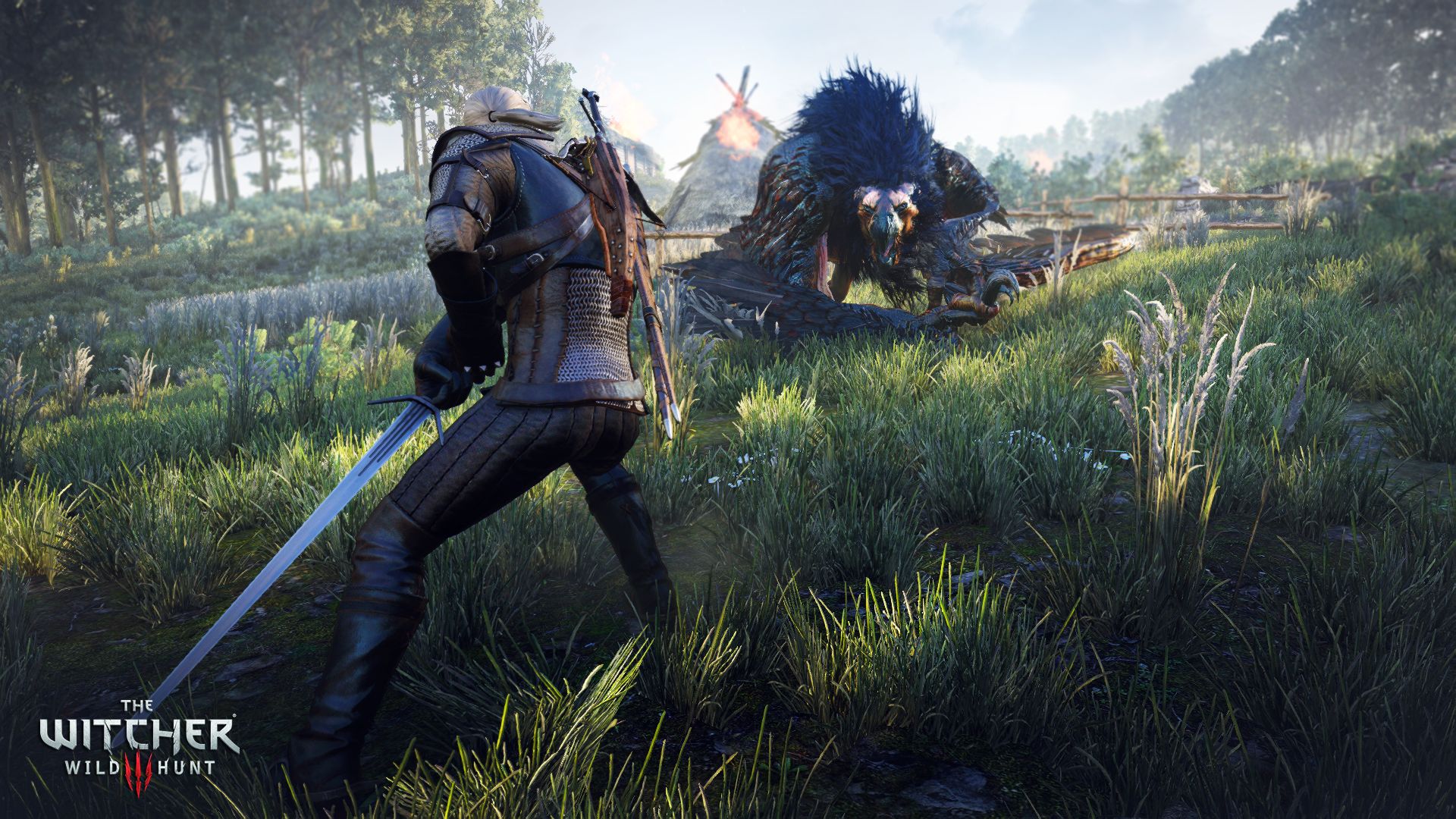
The game does have it's flaws though, like all games. I've had a few random crashes at places, which are rather annoying, and there are a few visual glitches, though those don't really interfere with the actual game. The biggest flaw though, is the inventory system. There are a lot of items you can pick up, for crafting, alchemy, etc, and the game clumps a lot of it together, which can be a huge pain to sort through. The movement can also feel clunky at times, and while the combat functions fine, investigating or picking up items can be a bit of a pain.
There's just so, so, sooooo much to this game, and all of it is kept to a premium quality, from the strategic card game you can obsess over, Gwent, to the monster slaying contracts you can find in the peasant villages. I've put about 30 hours into the game since release, and I'm nowhere near complete. While Assassin's Creed's and Far Cry's activity's in their open world's feel like obstacles to jump over, the side quests in The Witcher 3 all feel so fun in their own right, and are a joy to complete. While you'll enjoy the game a whole lot more if you have played the first 2 games, and I recommend playing them, you can still jump in at The Witcher 3 and have a blast playing it. Games are very expensive, and The Witcher 3 is no exception, but it's one of the few releases on the new consoles that I truely feel is worth the asking price.
- Great Combat
- Amazing World and Presentation
- Great Characters and Storyline
- Great....Well Everything
The Cons:
- Some Glitches and Crashes
- Messy Inventory System
Final Score: 9 out of 10
Tuesday, 31 March 2015
Video Game Review: Life is Strange: Episode 1 & 2
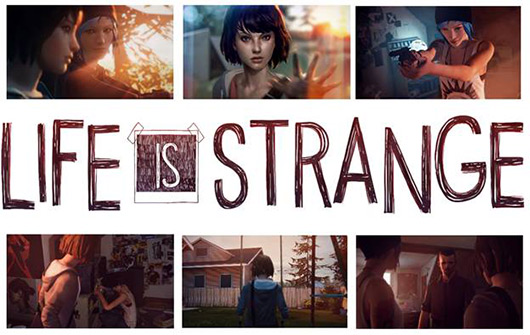
Title: Life is Strange: Episodes 1 & 2
Developers: Dontnod Entertainment
Publisher: Square Enix
Genre: Graphic Adventure
Platforms: PC, Playstation 3, Playstation 4, Xbox 360, Xbox One
Reviewed On: Xbox One
Price: $4.99 per episode, $19.99 for all current and future episodes
The most striking thing about Life is Strange, a new episodic series created in a similar vain to the recent Telltale releases, is the attention paid to the little details of the in-game world. Small things, like how all in-game sound is muted, except for music, when the protagonist puts in earbuds, or how looking at the writings and drawings of each person's whiteboard in the dorms gives an idea of their reputation and character, really bring the world of Arcadia Bay to life. While the game has a few technical issues that appear, most likely due to budget constraints, and the dialogue can feel a bit forced at times, it's an amazing case study of how important environmental details can be for a in-game world.
In Life is Strange, you take control of a high school girl named Max, an artsy loner in a school full of drama and hipsters. As you progress through the game, you have a variety of dialogue choices for how you interact with each character. These choices allow you to morph Max's personality, and can change how people see and react to you. Along with dialogue choices, there are also several bigger choices to be made, that have consequences later on in the story, mostly in the form of branching dialogues, but there are a few that can have rather dramatic waves, particularly in Episode 2.
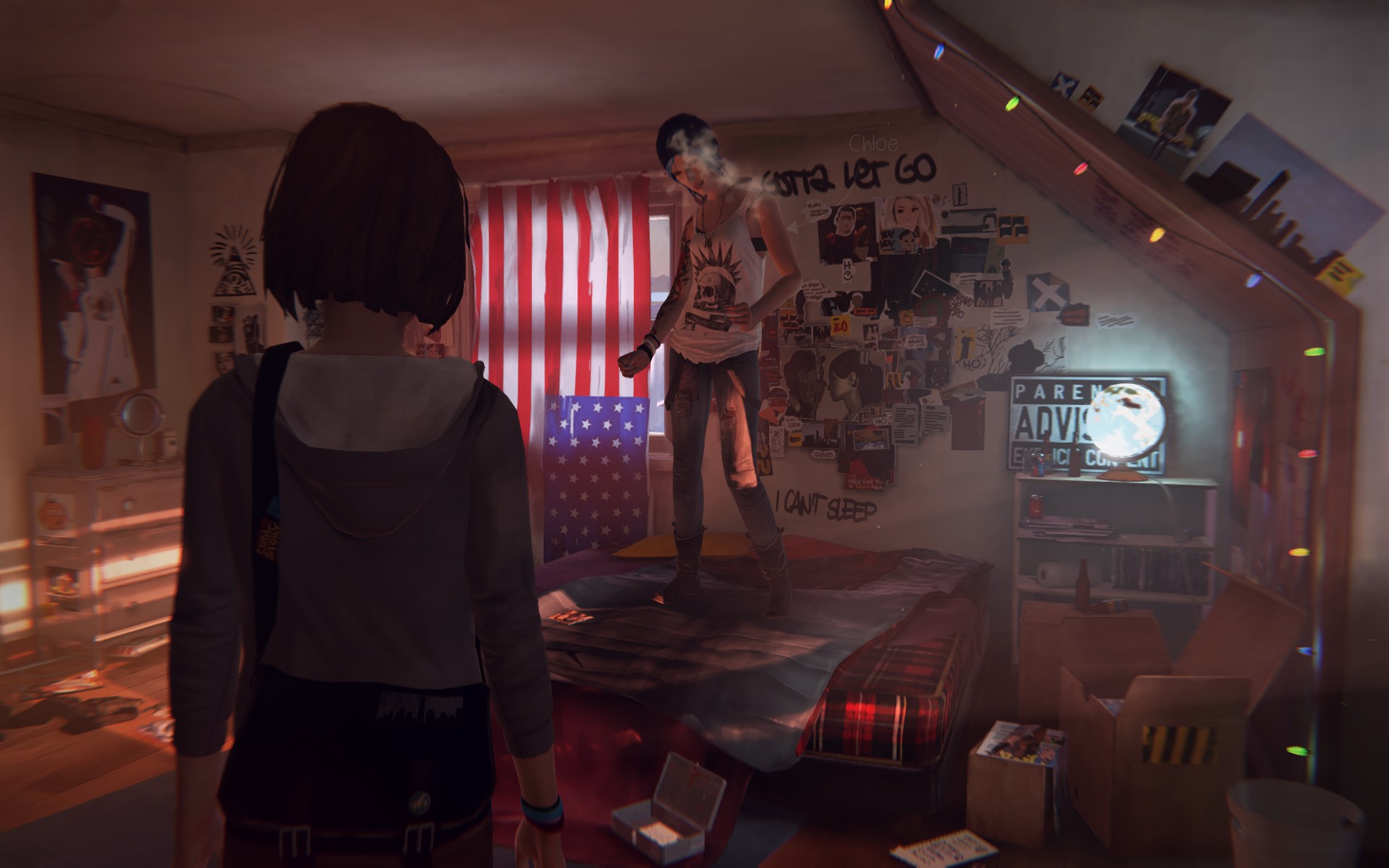
You may be thinking that this is just a high school version of a Telltale game, but Life is Strange has a special trick up its sleeve that kinda turns the choice-and-consequence gameplay format on its head, Max has the ability to travel backwards in time, and remake choices she made. Max also retains information she has found and small items she takes with her, allowing her to make different choices based on found information.
Going back to the little details, the game makes sure that you are never fully confident you made the right choice, by making sure Max herself is never confident. Every big choice you make, and are allowed to reverse time in, Max will have a little inner dialogue, asking if that was the right choice. It's a fantastic way of getting us more into the mindset of Max, and adds a lot to the games, for such a tiny thing. The game also shys away from showing black-and-white outcomes for each choice, nearly every one of the choices presented have a fairly grey outcome, and you will never be fully confident you made the right one, just like Max.

These little touches also apply to the characters in Life is Strange. At first, it seems like a typical hodge-podge of high school stereotypes. The jock, the punk, the prep, they all seem to appear here, but all of them (well, most) get fleshed out so well with little details about their personality. Seeing the college rejection letters of the mean prep can give you a better appreciation of why she's so mean and bitter, or seeing the terrible things written on a dorm whiteboard based on the religious beliefs of one of the girls gives you an idea of how tormented she may feel. This also comes through in the dialogue, and if you talk to each character, you can see their individual personalities shine through.
The environments of the game also step up to this challenge, and do a damn fine job of it. Looking around the dorms can really shine a light on a characters motivations and actions. Seeing the rejection letters held onto by the mean prep, or the terrible things written on a girl's room whiteboard based on her religious beliefs can really show you a side of the person in a way dialogue can't. In fact, later on in Episode 1, an entire level is dedicated to a main character, showing how a once happy home for her has changed into something less than happy. This level of dedication to environmental storytelling is completely welcome to this sub-genre, and a breath of fresh air.

Unfortunately, the game does have its flaws that need to be discussed. While the artstyle of the game is great, and can lead to some gorgeous sights, the animations of the characters can be sorta robotic and jarring to see. Fortunately, the voice acting is fantastic, the developers have stated that ensuring quality voice acting was more important to them than ensuring quality lip-syncing, and I wholeheartedly agree. Something a bit more of an issue is the dialogue in the game. For the most part, it's great, but it sometimes tries too hard to be hip and cool with the slang, which can feel forced and awkward at times. I noticed this as an issue in Episode 1, but less so in Episode 2, so it seems the developers recognized this issue.
Video games are growing as a form of media, and arguably, art. Life is Strange is a sign of this, with its merging of gameplay with great writing, and tackling the different themes of adolescence, identity, and memories. It does have it's issues, but the format of its releases, with several episodes released over the course of months, it has a unique opportunity to tackle those issues, and improve itself with each episode. If you always thought that video games are just mindless violence, or that they can't deal with heavy themes, then give Life is Strange a try, and be proven wrong.
Wednesday, 18 March 2015
Video Game Review: Hotline Miami 2: Wrong Number

Title: Hotline Miami 2: Wrong Number
Developers: Dennaton Games
Publisher: Devolver Digital
Genre: Action, Top Down Action, Virtual Drug Trip
Platforms: PC, Mac, Linux, Playstation 3, Playstation 4, Playstation Vita
Reviewed On: PC
Price: $14.99
**Be Warned: This game is INCREDIBLY violent. If hardcore violence bothers you, be sure to at least lookup some gameplay videos before you purchase.**
So, Hotline Miami was one of my favourite indie releases of last year. An insanely fast top-down action game that felt like some insane 1980's drug trip, with way more blood and guts then usual, and everything about it worked. The art style, the story, the music, even the gameplay, all added to the rush of the original, and most of that carries over to the sequel. It has some flaws that hit the game, mostly with a few of the levels, and its fair share of bugs, but when it gets it right, the game is an absolute blast.
Veterans of the first game will feel immediately at home here, as the sequel is basically the same with some improvements. For those who haven't played it, the game plays out from a top-down perspective, full of split-second thinking and tactics. You as the player can take maybe a bullet or two before going down, and a single melee attack from an enemy will down you, but same goes for the enemies, with a few having certain characteristics to throw you off, some can only be taken down by melee or guns, for example. Your character, along with enemies, can move very fast, leading to a speedy experience. Even resetting the level after death takes a second, allowing you to jump right back in.

While there are extra weapons and enemies in the game, the core gameplay remains the same. The major changes come from the masks, which can be chosen at the beginning of many levels. Masks, or similar items, can be chosen at the beginning of the level, which changes your gameplay style in drastic ways. This can be anything from allowing only punching which can one-hit kill enemies, to starting with dual machine guns. While the first game had masks, they didn't have the drastic changes like here. It's a definite improvement over the masks from the first game.
For most of the game, the level design is great, allowing speedy rushing through rooms with plenty of cover to lure enemies and not get shot, playing to the main strength of the core gameplay, its speed. However, the game has its fair share of levels that work against the game's strength. Many times, the game will throw large levels at you with very little cover. This can be extremely frustrating, as a few shots will kill you, and enemies have a large sight range, many times rushing you from outside your own camera view. Many times, a level will also be full of windows, which enemies can see through, and if said enemy has a gun, this can be a death sentence.

But what about the graphics? Well, they look beautiful, in a weird, drugged-up kind of way. The game has an 8-bit style to it, and brings a full colour palate to the table. Everything in the levels look vibrant, with a sea of colours flowing in the background, and vibrant environments, including forests, prisons, and grungy buildings. The animations of the game are also great-looking, with little details there, if you notice them. There's also the music. The music is one of the best parts of the game, with frantic disco-like tracks blasting over the on-screen brutality.
There's also the story, and if any of you play it, and can tell me what the plot is, you go right ahead. The plot is a jumbled mess of flashbacks, odd characters, sociopaths, soldiers, and murder sprees, along with some mysterious phone calls that cause people to commit horrible massacres. The writers also love to play mind games with the player. Through the game, you will never be quite sure exactly what's real and what's not. While a plot like this would normally be panned, it fits into the atmosphere here, adding to the jumbled mess this game creates. When analyzing the storyline though, it's kind of a mixed bag. Some characters work, some don't, some plotline works, some don't.

There's also technical issues with the game, besides the sometimes iffy level design. Many times, I've noticed enemies get stuck in doorways, causing their AI to freak out and spin around. It can also be a pain to try and pick up specific weapons on the ground, as you cannot choose a specific weapon if they're in a pile. I've also noticed that doors can be sometimes inconsistent about knocking down enemies. Overall, the glitches in the game are there, but they don't effect the game too much, at least in my playthrough.
Overall, if you want a fast-paced action game with a lot of strategy, definitely check out Hotline Miami 2, and the first one. If you want a game that creates a visual and audio drug rush, give this a try. The gameplay is incredibly addictive, with fast, fun gameplay, and a scoring system that encourages you to perfect your strategies for each level. Despite its flaws, the game manages to live up to the original's quality, and is worth playing.
Sunday, 8 March 2015
You Should Play: Metal Gear Rising: Revengeance

Title: Metal Gear Rising: Revengeance
Developers: Platinum Games/Kojima Productions
Publisher: Konami
Genre: Action, Spectacle Fighter, Over-The-Top Insanity
Platforms: Xbox 360, Playstation 3, PC
Reviewed On: PC
Lately, I've been looking back on my massive Steam library, looking for something different to gnaw on. A quick scan made me remember that I have MGR. I remember when I played it a while back, and how much fun I had with it, so I installed it and got to playing. I've since logged about 50 hours into it, and beat the game on every difficulty. I always knew that the game was damn fun, but I had forgotten how damn satisfying this thing is.
For those of you who may not know about the spectacle fighter genre, games like Devil May Cry, Bayonetta, and God Hand, for reference, a quick recap. The games in this genre generally are extremely fast paced third-person action games, full of combos, quick-time events, and sheer insanity. Think God of War, but twice as fast. The genre is also characterized by it's very high skill ceiling. The combat systems in these titles have a serious amount of depth to them, and if you spend the time mastering them, it's amazing to see your inputs turn into amazing fights on screen.

As for the gameplay, it works in a similar way to other third person action games, but with a few core differences. You have multiple types of attacks at your disposal, with a Light Attack, a Heavy Attack, and several other weapons that can be unlocked over the course of the game. Fairly normal stuff, until you get to your defensive abilities. Metal Gear Rising seems to have disdain for people who stop for a defensive position, so you can just throw that idea out. Instead, you get a parry. By pressing the Light Attack in the direction of an attack, you will block the enemy's hit, and allow you to get some free attacks in. Should you parry right before an attack lands, you will counter it, doing massive damage, and may even kill the enemy in one hit. There is also no dedicated dodge button, although dodge does exist as an ability, but it's easier to parry an enemy than dodge them. This change marks a difference in the feel of the game, as constant offense is also your defense, if you are not attacking in Metal Gear Rising, you're probably not playing it right.
What cannot be said enough, is how much fun this game is to play. Enemies recoil from your hits and parries, and the game shows particle and slicing effects for every slash, clashing with a loud metal clash. For crazy parries and counter-parries the game slows for a second, letting you marvel over your skills for a quick moment before going back to killing evil cyborgs. By far though, my favourite gameplay feature is the Blade Mode. Blade Mode slows everything around you to a crawl, letting you control the directions of slices. You can also cut your enemies into pieces. Not 2, not 4, but hundreds of pieces. Even better, you do not heal naturally over time; instead, you slice your enemy through the middle and rip out their robo spine and crush it in your hand, called the Zandatsu in-game, which heals you to full health. I've done this move hundreds of times over the course of my playthroughs, and it has not lost one bit of satisfaction. Seriously, everything in this game is cranked to 11 from the start, and it doesn't ever drop.

By far though, my favourite aspect of the game is the boss fights. Out of the hundreds of games I've played, these boss fights top them all. They're challenging, unique, with each putting a specifc aspect or twist of the gameplay against you, all while providing an amazing spectacle to show. If you want to play a game where a boss fight consists of a three-story death robot, where you grab it by the sword and throw it up into the air, this is the game for you. The final boss lives up to the expectations as well, challenging you in each aspect of the game, testing the skills you've developed over the course of the game.
Topping off the boss fights is the soundtrack. This is the absolute perfect soundtrack for this type of game, with frantic speed-metal playing throughout the fights. The music also dynamically shifts over the course of the fight, with faster verses and vocals kicking in at certain points during the boss fight. This is my absolute favourite soundtrack from any game, and I listen to it out-of-game frequently.
The amazing boss fights and quick gameplay are also helped with incredible replayability. There is an upgrade system, with each weapon in the game having a large amount of upgrades for you to purchase, using a currency you earn based on how well you perform in each fight. These upgrades carry over to new difficulties, and it's a lot of fun to try and upgrade everything to the max. The game itself is also short, around 6-7 hours. This can be a good or bad thing, based on how much you enjoy replaying games after completion. There's 5 difficulty modes as well, with enemies receiving new placements as well as tactics in later difficulties, rather than just a simple health and damage boost.

Next, the story. The story is a continuation of the Metal Gear Solid storyline, picking up some time after the ending of Metal Gear Solid 4. You play as Raiden, a character familiar to Metal Gear Solid 2 players, as he battles a rogue Private Military Company filled with violent, emotionless cyborgs. The story, despite the short length of the game, is entertaining, and while not as deep as the Metal Gear Solid storyline, it does deal with some themes related to child soldiers and the industrialized nature of war in a modern setting. It works for the gameplay and style here.
One other important aspect to mention, is the graphics and technical aspects of the game. This game's main strength is the speed of it's gameplay, and Platinum Games recognized this. They made the wise decision to keep the game running at 60 frames per second, and it feels so good in this title. Input speed is a crucial feature, and the framerate boost means there is little to no input lag here. Despite the need to keep the framerate high, the graphics still manage to look good. They're nothing to write home about, some textures can look kinda dated and blurry to look at, but it does what it needs to, and looks pretty enough to not be a problem.

You probably think this game is damn near perfect, from the previous paragraphs, but sadly, no. There's some issues that have come up in my playthroughs that I do need to talk about, mainly the camera and environments. The main problem with the camera is the third-person perspective of it, and how it affects parrying. An example, you're parrying a series of attacks from an enemy, and the camera swings around to the opposite side of the character, which direction will you push to parry the enemy now? The camera has a nasty tendancy to do this, but I've never had it happen enough for it to be a game-breaking issue. The camera generally functions well, but it could use some improvements.
The environments of the game are, well, generic. You've got a city, a sewer, and other real-world places that just aren't that interesting compared to everything else in the game. To be fair, this might have a lot to do with the Metal Gear setting, you can't have the most interesting environments in a setting based on the real world. It would also seem that much interactivity with the environment was stripped out, possibly to make the framerate possible. I'm sad a lot of that had to go, but I understand that the speedier gameplay was more important.

In conclusion, I absolutely adore this game, despite its issues. Despite the camera being a pain sometimes, the gameplay is just so damn satisfying to play, helped by the incredible soundtrack and insane bossfights. If you are looking for a fast-paced action fighter with a high skill ceiling that doesn't take itself too seriously, look no further than Metal Gear Rising: Revengeance. The studio also has several other games for both the old and new consoles. If you enjoy Metal Gear Rising, look into the Platinum Games library.
Monday, 23 February 2015
Video Game Review: Hand of Fate

Title: Hand of Fate
Developers: Defiant Development
Publisher: Defiant Development
Genre: RPG, Card Game, Roguelike
Platforms: PC, Xbox One, Playstation 4
Reviewed On: Xbox One
Lately, I've been fairly disappointed with the AAA game market. Very few of these blockbuster titles have offered something truly new and creative, with a few exceptions. I've had to look towards the much more fragmented indie market to really see the creativity of developers flow, and I've definitely found a good choice in Hand of Fate, the new Kickstarter-backed release from Defiant Development.
The premise of the game is a bit complicated, so bear with me. The game is a combination of deckbuilding, Batman: Arkham style combat, and tabletop-style adventuring, with you building a deck of custom cards, and the game generating an adventure based on that deck. You can have two separate decks to construct an adventure, an equipment deck, which includes things like weapons, armor, and shields, and an encounter deck, which contains the events that will create your adventure. Sound complicated? It really isn't, but it's much easier to grasp while playing, rather than having it explained. The deckbuilding doesn't need to be done either, if it doesn't interest you, as the game can generate a recommended set of decks, allowing you to jump right into the game.

Once created, the adventure starts. You move your character to each card in the adventure, through various combat and non-combat encounters. The non-combat encounters have a choose-your-own-adventure style choice to each one, providing different rewards or challenges based on what you choose. There are a huge amount of these encounter cards in the game, and many encounters will give you more cards at the end of the adventure, allowing you to diversify the adventure more and more, the further you get in the game.
There are also combat encounters that appear in the game, with the combat itself performing in the vain of the Batman: Arkham series, or Shadow of Mordor. You have the ability to attack, dodge, stun, and counter, should you find a shield. It's functional, but not much more than that. It simply lacks the production values of either of the aforementioned series, which leads to the combat feeling floated and not very satisfying.
The combat, however, doesn't affect what is by far the best part of the game, the presentation. Over the course of the game, you will be playing the game with a mysterious cardmaster, and he breathes so much life and personality into the game. He reacts organically to the cards drawn, and makes various remarks as you play through the game. Cards fly across the screen and shuffle, cards equip your character as you spawn, and enemies spawning from cards. It creates a sense and atmosphere of playing a tabletop card game, and is by far the best part of the game.

That being said, the game has some definite flaws, mostly technical, and a few design issues. On the Xbox One version, I've noticed a fair few framerate drops, particularly when there are a large amount of cards floating on screen. I've also noticed these drops happening during combat, albeit rarely. The combat, mentioned above, feels floaty, due to the animations and sound effects, although this most likely has to do with financial limitations of independent development.
I stated above that the independent game developers seem to be the ones with the creative, ambitious ideas in the gaming industry, and Hand of Fate is a perfect example of that. In a AAA gaming industry filled with uninspired clones and fun base games with no content, the independents are more and more stepping up to the base, and I will gladly support them. If you enjoy card games, RPGs, roguelikes, or table-top games, Hand of Fate is by far worth the $20 price tag. If you're looking for a new, interesting experience, give this one a shot, I don't think you'll be disappointed.

The Pros:
- Great Presentation
- Addictive Card Collecting and Deck Building
The Cons:
- Some Technical Issues
- Floaty Combat
Final Score: 7 out of 10
Sunday, 26 October 2014
Video Game Review: The Evil Within

Title: The Evil Within
Developers: Tango Gameworks
Publisher: Bethesda Software
Genre: Survival Horror
Platforms: Xbox 360, Xbox One, Playstation 3, Playstation 4, PC
Reviewed On: Xbox One
Well, I am not going to forget some of the stuff I saw in this game. Don't think of that as a negative, it's a positive for some absolutely awesome art direction and work. While Alien: Isolation leaned more towards the sterile, metallic atmosphere of the 70's Alien film, The Evil Within thrives on showing the stuff of nightmares. If you have a weak stomach for gore, I would not advise this, it goes all-out on the horrifying gore factor. For the rest of you, and you fans of Resident Evil 4, you definitely need to consider this one.
The Evil Within has a strong pedigree. Directed by the man who is considered the grandfather of survival horror, Shinji Mikami, the creator of the Resident Evil series, he has done a great job bringing his brand of survival/action horror to the next-generation of consoles, despite a few flaws that can hamper the game. He is helped by the people in his studio, Tango Softworks, many of whom worked at reputable companies before, including Platinum Games, Clover Studios, and Capcom.
The strongest part of the game is the atmosphere. It seems that The Evil Within wants you to feel trapped in the nightmares of an insane man, and it has done this perfectly. You will travel through mental hospitals, forests, medieval villages, and crumbling cities, all brought to life beautifully. The forests are dark, the hospitals are dirty and bloody, and it all creates the feeling of being trapped in a world of Insanity brought to life. There is some great sound design that really helps too, from dripping blood, to roaring chainsaws, that completes the nightmare.

The gameplay present here will feel instantly familiar to fans of the acclaimed Resident Evil, and third-person shooters, with a few tweaks and enhancements present. The game plays as an over-the-shoulder third-person shooter, with guns used for combat, and a basic melee attack. The main strength of the gameplay is that it truly feeling like survival horror. Ammo is limited for your weaponry, and creative use of both it and the environment is a must. The game is usually fair about this however, and there is always a way to survive through the clever use of the environment. Traps litter places where fighting is the only option, along with enough ammo littered around to get by, and if you are smart with using both of these tools, you will survive. Fire is an important weapon as well. Matches can be used to burn both corpses on the ground, and enemies on the ground, allowing for some quick kills, if you are creative enough.
The gameplay is not perfect however, with one of the negative sides also being the lack of ammo. There are sections where you are forced to fight, and the game will be very stingy with its ammo. This can lead to some very frustrating trial-and-error tactics, which are never fun to do. Thankfully, I found that these sections are quite rare, as there are usually alternative tactics to use then just straight shooting. There is also the core control scheme of the game. The game does control like an improved (except for the aiming) version of Resident Evil 4. This works great when enemies are at a distance, and starts to break apart when enemies are close to you. The aiming is the main problem here, with its awkwardness showing at full force with enemies in close range. So then just melee the guy! Melee in this game is a very last resort type of attack. It doesn't do much damage, and really only serves to get enemies away from you. This can lead to a lot of frustration, although it is an understandable decision made by the developer. You are fighting monsters, how much good can punching them really do.
Stealth is also an available tactic, but this aspect of the game feels a bit tacked-on. You can crouch to stay out of sight, throw bottles as a distraction, and even perform stealth kills on unaware enemies. When this aspect works, it works well, and allows you to clear out large portions of enemies with little to no resource use, if you are skilled enough. But many times in the game, stealth will not be an option for you to use. This is partially because of forced combat sections, and because of the AI of the enemies in the game. The AI can feel cheap at times, and immediately turn around when you are just outside of the stealth kill range, and ruin any plans you have. While this can feel like a screw-up on your part sometimes, there are quite a few times when it just feels like the AI has a sixth-sense for sneaking detectives.

The variety of metal-shooters in the game is great. There are close to 6 or 7 types of different weapon types within the game, with different unlockable and findable weapons for each type.The sound and feeling of these guns are great too. Pistols feel like pistols, with several rapid pops, and shotguns go off with a loud and damaging bang. The standout weapon of the game, however, is the Agony Crossbow. Parts can be found in the world, and collected from disarmed traps, and can be used to create ammunition for the Agony Crossbow. The disarming traps aspect allows for depth and choice, do you use the traps against your enemies, or use the parts to create powerful ammunition for your crossbow? The Crossbow itself also has a variety of ammunition, from exploding bolts, to harpoon bolts, and with some creativity, can be one of the most powerful weapons in the game.
As for the storyline, it starts off great, with you having no knowledge of what is causing the horrors you see, and you slowly discover this over time. It loses some of its steam later on in the game though, and while not terrible, the story is average at best. The characters, by far, are the weakest aspect of the story. Sebastian Castellanos is any average, gruff guy detective, although slowly discovering his backstory over the course of the game is interesting at least. The side characters are a bit more interesting, although not much time is spent with them. The villain, however, is the best character. He is not the most interesting character, but his backstory is well told through play, rather than cutscenes, and this allows for a more interesting character to develop.
All in all, Shinji Mikami has shown with The Evil Within that he and his group of developers can still pull off great survival horror games in this next-generation. There are flaws in the game, mainly the storyline, some awkward controls, and frustrating encounters, but there is a lot of good here. The atmosphere here is top notch, and the gameplay, when it works, is a lot of fun. The Evil Within gives me a lot of hope for the future of Tango Gameworks, and I hope that they continue to improve and perfect their future projects.
Final Score: 7 out of 10
Tuesday, 21 October 2014
Video Game Review: Borderlands: The Pre-Sequel!

Title: Borderlands: The Pre-Sequel!
Developers: 2K Australia, Gearbox Software
Genre: RPG, Shooter, Role-Playing Shooter, co-op shooter
Platforms: Xbox 360, Playstation 3, PC
Reviewed On: Xbox 360
Well, the addiction kicked back in, that same addiction that kicked in when I first started playing the original Borderlands, and the one that came right back when I started Borderlands 2. For those of you worried about the The Pre-Sequel, about whether the new developer, 2K Australia, could make Borderlands properly, you can put most of those worries to rest. Despite a fair few flaws in the game, this is Borderlands, through and through.

The game is set on Elpis, the moon of Pandora, the one that was all cracked, and had a Hyperion moonbase on it that shot robots at you, and on that moonbase itself. The storyline, as the name suggests, is a prequel to Borderlands 2, showing just how Handsome Jack became the hilarious sociopath he is in Borderlands 2, and just how he came into control of Hyperion, and the moon base, Helios. This creates several interesting gameplay changes, and map changes, that 2K Australia have put to use, both for good and bad.
If you have played Borderlands 2, you know almost exactly what you are in for. For those of you who haven't played Borderlands, here's the rundown. The game plays as a shooter version of Diablo. You create a character, choosing from 1 of 4 preset characters, along with 3 other friends, if you like, each with their own abilities and skill trees that are all interesting in their own right, with different abilities to help you fight, or help the team fight. As you level up, you get stronger and stronger, building the skill tree of your character. All of this, is in service of the loot system at the heart of the game. This game, is about guns. Guns here, guns there, guns EVERYWHERE. There are millions of guns in the game, and each gun chest is randomized for which it gives you. No two players will ever have the same loadout of guns, shields, and class mods.

Borderlands: The Pre-Sequel has not changed the base gameplay. The great looting and tight shooting are here, unchanged. 2K Australia did add several elements, that fit great into the moon setting of the game. Due to the low gravity, players can now jump much higher than in the previous games. This adds a great element of verticality to the gunfights, and provides more options for the player when their shields run low, rather than just ducking behind cover. Being on the moon, there is also the fact that there is no oxygen on the moon, which means that an O2 helmet is required, and adds oxygen as a resource, which slowly drains when outside on the moon's surface. The extra oxygen also allows for an extra boost in mid-jump, which makes it easier to reach taller or farther ledges, and allows for the self-titled "butt slam", a slam which, when done high enough, creates an area-of-effect shockwave. This is great for dealing with groups of lower level enemies, instead of wasting bullets on them.
The team also added new weapon types to the already stupid amount of weapons in the game. One is a new elemental type for all weapon types in the game, and that would be Cryo weapons. Cryo weapons do exactly what they sound like, they freeze enemies. This can be extremely useful for both crowd control, as you can freeze various enemies in a fight to stop them in their tracks, and for damage, as you do extra damage to frozen enemies, and shatter them when they are killed. The other weapon addition is an entirely new subset of weapons for use, lasers. Lasers have existed before in Borderlands 2, as E-Tech weapons, but they were extremely rare and powerful. Lasers have been bumped up to a regular use weapon. There are a variety of different ones for use, everything from shotgun lasers to rifle lasers to a Ghostbusters style laser, which is dependent on the manufacturer of the weapon. Laser weapons can also have elemental damage attached to them. If you looked at me and told me you wouldn't enjoy a Ghostbusters laser gun that freezes people, I'd call you a damn liar.

I'm sure you're also curious about the classes available for you to choose from. Like the past two games, there are four classes to choose from. Unlike Borderlands 1 and 2, that had some common classes between them, the characters present in The Pre-Sequel have totally unique skills between them all. First is Wilhelm the Enforcer, a character that was present as a large robotic boss in Borderlands 2. Wilhelm's special skill is Wolf and Saint, this allows Wilhelm to throw out two robots for combat. One robot, Wolf, is the combat bot, and assists in combat, while his other robot, Saint, acts as a support for the players. The second character, Athena, who made a cameo in the General Knoxx DLC from the first game, uses the skill Kinetic Aspis, which allows her to pull out a kinetic shield which charges from gunfire, and can be thrown. The third character is Nisha, a boss from Borderlands 2, uses the Showdown skill, which lets Nisha lock on to enemies when firing. The final character, Claptrap, a character present through both games, has arguably the most interesting skill, VaultHunter.exe. This skill reads the battlefield, choosing several variables, and gives the player a skill based on the variables. Claptrap has a large variety of different skills available, and the developers made sure to make each one useful to the situation, including causing the team to be uncontrollably bouncy. The only issue I have with the characters, is that Claptrap is the most interesting, while the others are rather ho-hum. This means you'll probably see a lot of Claptraps when playing online.
It's not all bouncing and butt-slams though, as the oxygen resources leads into one of the games biggest problems, namely, the environments. There are large expanses of the moon that, while pretty to look at, are empty. While the new Moon Buggy and Stinger do help somewhat with this, there a a fair few areas that do not allow vehicles, and the areas that do allow them are full of death pits. These lead to a lot of frustration and time spent driving around the pits, or dying in them. There are also geysers littered around the moon that can fill up your Oxygen, and while the dev team tried to make these geysers plentiful, there can still be times that you will need to backtrack again and again, just to fill your oxygen. At least until the second half of the game, the map design is the weakest part of The Pre-Sequel. Its a shame, since the maps can be quite fun to jump around in and admire, when they are not killing you.

This leads to another flaw of the game, the storyline and characters. There are many new characters introduced in The Pre-Sequel, most of which have an Australian accent and use Australian slang. This may get a laugh or two, but many of the new main characters are fairly hit-or-miss, leaning more to the miss category for me personally. The quests are fairly creative and fun to play through, but the characters are a mixed bag. There are many returning characters however, and their writing is as fun and creative as ever. This really shows in the later half of the game, when the dialog leans more towards the returning characters, rather than the new ones.
All in all, I really liked Borderlands: The Pre-Sequel. It's still damn fun to grab a few buddies, a few beers, and play split-screen/system link through the game, despite the fairly large flaws in the gameplay. That said, this one is for the Borderlands fans, as this game carries the same gameplay from Borderlands 2, flaws and all. For those of you that enjoyed Borderlands 1 and 2, feel free to pick up The Pre-Sequel, you'll enjoy it. As for the rest of you that don't enjoy Borderlands, don't bother, The Pre-Sequel won't change your mind.
Final Score: 7 out of 10
Wednesday, 15 October 2014
Video Game Review: Alien: Isolation

Title: Alien: Isolation
Release Date: October 7th
Genre: Survival Horror
Platforms: Xbox 360, Xbox One, Playstation 3, Playstation 4, PC
Reviewed On: Xbox One
Reviewed On: Xbox One
As I lay underneath a table, watching the Alien slowly slide out of a ventilation opening, the Alien fanboy in myself was screaming both with terror and with joy, knowing he had found something special in Alien: Isolation. Finally, a game that treats the original H.R. Geiger monster, and the franchise, in general, with the respect it deserves.
The game is set 15 years after the original Alien film, with the player taking on the role of Amanda Ripley, the daughter of Ellen Ripley, and a technicial at the familiar Weyland-Yutani. Amanda has been searching for her mother, and finally catches a break when the black box of the Nostromo is recovered, and stored on the space station Sevastopol. She joins several other Weyland-Yutani employees to recover it, and finds a station in absolute chaos.
If you get learn one thing from this review, let it be this, the atmosphere of this game is some of the best I have ever seen. The amount of love and detail that went into the environments to recreate the original Alien aesthetic is absolutely mind-boggling. There is not a single item that feels out of place in the futuristic, utilitarian environment, and every part of it would fit perfectly into the original Alien film. Everything has a very mechanical, 1970's sci-fi feel to it, there are no sleek, iPod designs in this game, from the large-pixel hacking device and DOS and CRT-monitor computers, to the green, blinky, and bulky motion detector, looks retro, yet are highly functional. Sevastapol is also full of florescent lights, and metallic hallways, with perfect lighting to ramp up the tension.

The sound design is also phenomenal, and truly completes the atmosphere of the game. I give the sound team a lot of credit, as they did an amazing job of recreating the sound of the original film, and Alien fans will recognize plenty of sound effects from the first film. The station creaks and shifts as your footsteps echo through the empty corridors. As you walk, you can always hear something crawling through the vent system, you will never feel truly safe on Sevastapol. The Alien was also treated great in this department. It's truly a rush, as you hear the Alien stomping down a hallway towards you, and hissing in frustration when it cannot find you.
The sound design is also phenomenal, and truly completes the atmosphere of the game. I give the sound team a lot of credit, as they did an amazing job of recreating the sound of the original film, and Alien fans will recognize plenty of sound effects from the first film. The station creaks and shifts as your footsteps echo through the empty corridors. As you walk, you can always hear something crawling through the vent system, you will never feel truly safe on Sevastapol. The Alien was also treated great in this department. It's truly a rush, as you hear the Alien stomping down a hallway towards you, and hissing in frustration when it cannot find you.
As for the gameplay, this is some of the best survival horror gameplay I have seen in a long time. What sets it apart from other horror games, is that you cannot fight the Alien. Don't even try. It can also run a lot faster than you, and will get you if you try to run. Your only option is to hide from it, and Sevastapol is not short on places to cower. There is an unmatched rush, hiding in a locker, as you pull back and hold your breath, while the Alien sniffs inside. Many times, your best friend will be the beautifully recreated motion tracker, which will detect any movement in a large area. The team, however, was smart, and the motion tracker does have some flaws, to prevent it from becoming a crutch. The motion detector can detect motion all around you, but can only pinpoint it in front of you. It also cannot tell you whether the motion is on the same elevation of you, leading to some tense moments as you explore, not knowing whether the Alien will be in a vent hiding, or directly in front of you. The detector also beeps as it points out targets, and enemies can hear it if they are close enough, which can get you killed.

Stealth is your best friend in the game, as ammunition is extremely difficult to come by, and it is completely useless against the Alien, at least until a bit later in the game. It has great hearing, and will hear you if you sprint. This allows for great on-the-spot decision making, is it worth alerting the Alien to get to another room or objective? Running and hiding are not your only options, however, you have plenty of tools at your disposal, both found and crafted from items you scavenge around the station. These items can be used as distractions, or to defeat the humans and androids scattered around the station.
There are several threats aboard the Sevastapol, not just the Alien. Androids called Working Joes stalk the halls, while humans group together hoping to survive. Both can be killed through conventional means, however, the Androids are exceptionally strong, and take several wrench hits or bullets to take down, making groups of them extremely dangerous, and even one can be a large drain on your limited resources. Humans generally have firearms, and travel in groups, but are easy to take down with a wrench hit or gun. Gunfiights are extremely discouraged, although quite doable. You don't want to deal with the Alien coming to investigate what all the gunfire is about, after all. The Androids, created by Seegson Corporation, are less advanced technologically than the Weyland-Yutani androids seen in the films, and are extremely creepy to see, due to their red, glowing eyes and rubber face masks.
But obviously, the Alien is the star of the show in the game, and the development team took this to heart, and recreated it in loving detail. The design is based on the original films design for the Alien, and it's model and animations look great. It has a very feminine walk, and it's tail slithers around corners and doors. The Alien also differs from many stealth games in the way that its AI works. It does not operate on a set path, and is unpredictable. You will never truly know where it will walk, or when it'll decide to hop down from a vent to give you a heart attack. The Alien also never truly leaves, you will always hear it crawling through the vents, looking for you, and going for the perfect strike.

That doesn't mean that the Alien's AI is entirely flawless, unfortunately. The sheer unpredictability can make the Alien a bit frustrating to sneak around, and there is a good chance you will sit for a long time for the Alien to walk off, only to have it come right back into the same room. This also makes the game extremely difficult, and you will die a lot, as the Alien can one-hit kill you. I never found the Alien to be unfair, it does have rules in it's AI routine that it follows, although some people may find it to be unfair.
Finally, we get to the story. The story is serviceable, and fun to play through, but nothing spectacular. The story generally deals with how the Alien was brought aboard and survived on the Sevastapol, with a few fairly foreseeable twists that fans of the films will see coming. Completionists will also find some recordings done by the crew of the Nostromo, giving some history and backstory to the terrible fate of the crew, which are a treat to find.

But now to the flaws of the game, of which there are a few. There are some parts of the game that just feel unpolished. I noticed that the Alien would clip into the textures of the locker sometimes as it sniffed for me, and the lip-syncing of some of the characters in the cutscenes and gameplay was kinda off, sometimes not even there, which works for making the androids creepy, but looks strange to see on a person across from you. The game also has some framerate drops at times, particularly in the later levels of the game. It's not enough to ruin the game, but can be quite jarring at times.
That said, despite all the flaws of the game, it is an absolute blast to play. They truly emphasized the "survival" aspect of survival horror game play, with scarce resources and unstoppable enemies, and an Alien enemy that is punishing in its unpredicatbility, but fair in the rules it follows. These things lead to some of the most tense gameplay I have experienced in a long time, and definitely make up for the flaws that exist in the game. Pick this up if you are a fan of survival horror, or a fan of the original Alien film. If you are both, it's a must buy, no question.

Final Score: 8.5 out of 10
Stealth is your best friend in the game, as ammunition is extremely difficult to come by, and it is completely useless against the Alien, at least until a bit later in the game. It has great hearing, and will hear you if you sprint. This allows for great on-the-spot decision making, is it worth alerting the Alien to get to another room or objective? Running and hiding are not your only options, however, you have plenty of tools at your disposal, both found and crafted from items you scavenge around the station. These items can be used as distractions, or to defeat the humans and androids scattered around the station.
There are several threats aboard the Sevastapol, not just the Alien. Androids called Working Joes stalk the halls, while humans group together hoping to survive. Both can be killed through conventional means, however, the Androids are exceptionally strong, and take several wrench hits or bullets to take down, making groups of them extremely dangerous, and even one can be a large drain on your limited resources. Humans generally have firearms, and travel in groups, but are easy to take down with a wrench hit or gun. Gunfiights are extremely discouraged, although quite doable. You don't want to deal with the Alien coming to investigate what all the gunfire is about, after all. The Androids, created by Seegson Corporation, are less advanced technologically than the Weyland-Yutani androids seen in the films, and are extremely creepy to see, due to their red, glowing eyes and rubber face masks.
But obviously, the Alien is the star of the show in the game, and the development team took this to heart, and recreated it in loving detail. The design is based on the original films design for the Alien, and it's model and animations look great. It has a very feminine walk, and it's tail slithers around corners and doors. The Alien also differs from many stealth games in the way that its AI works. It does not operate on a set path, and is unpredictable. You will never truly know where it will walk, or when it'll decide to hop down from a vent to give you a heart attack. The Alien also never truly leaves, you will always hear it crawling through the vents, looking for you, and going for the perfect strike.
That doesn't mean that the Alien's AI is entirely flawless, unfortunately. The sheer unpredictability can make the Alien a bit frustrating to sneak around, and there is a good chance you will sit for a long time for the Alien to walk off, only to have it come right back into the same room. This also makes the game extremely difficult, and you will die a lot, as the Alien can one-hit kill you. I never found the Alien to be unfair, it does have rules in it's AI routine that it follows, although some people may find it to be unfair.
Finally, we get to the story. The story is serviceable, and fun to play through, but nothing spectacular. The story generally deals with how the Alien was brought aboard and survived on the Sevastapol, with a few fairly foreseeable twists that fans of the films will see coming. Completionists will also find some recordings done by the crew of the Nostromo, giving some history and backstory to the terrible fate of the crew, which are a treat to find.
But now to the flaws of the game, of which there are a few. There are some parts of the game that just feel unpolished. I noticed that the Alien would clip into the textures of the locker sometimes as it sniffed for me, and the lip-syncing of some of the characters in the cutscenes and gameplay was kinda off, sometimes not even there, which works for making the androids creepy, but looks strange to see on a person across from you. The game also has some framerate drops at times, particularly in the later levels of the game. It's not enough to ruin the game, but can be quite jarring at times.
That said, despite all the flaws of the game, it is an absolute blast to play. They truly emphasized the "survival" aspect of survival horror game play, with scarce resources and unstoppable enemies, and an Alien enemy that is punishing in its unpredicatbility, but fair in the rules it follows. These things lead to some of the most tense gameplay I have experienced in a long time, and definitely make up for the flaws that exist in the game. Pick this up if you are a fan of survival horror, or a fan of the original Alien film. If you are both, it's a must buy, no question.
Final Score: 8.5 out of 10
Subscribe to:
Posts (Atom)